
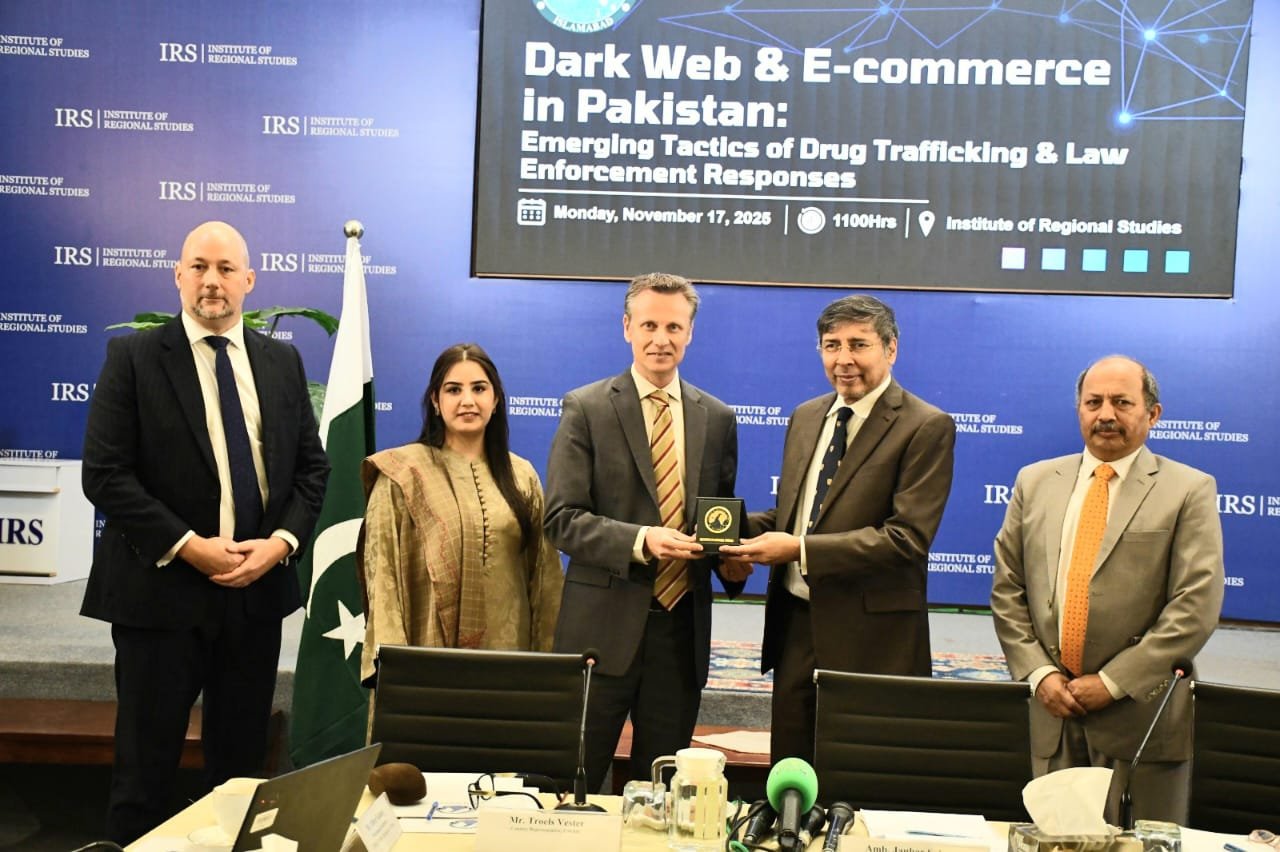
Islamabad: The Institute of Regional Studies (IRS) convened a special session to assess the evolving digital landscape that is increasingly enabling sophisticated forms of drug trafficking. The session was titled “Dark Web and E-Commerce in Pakistan: Emerging Tactics of Drug Trafficking and Law Enforcement Responses,” under its Cyber Security Program led by Ms. Alina Fayaz. The discussion brought together diplomats, government officials, and international experts.
IRS President Warns of Growing Online Threats to Youth
Ambassador Jauhar Saleem, President of IRS, opened the session by warning that while online platforms offer vast opportunities, their ease of access also exposes young people to criminal activities, including the purchase and sale of drugs. He emphasized the urgent need to enhance state capacity, train cyber-crime specialists, and upgrade investigative agencies such as the FIA. He further underscored the importance of inter-agency coordination and knowledge-sharing to counter increasingly advanced online drug-trafficking methods.
UNODC Highlights Dark Web’s Expanding Role in Drug Trafficking
Troels Vester, UNODC Country Representative, said the Dark Web has emerged as a powerful facilitator of cybercrime, offering anonymity for a widening range of illicit activities, including drug trafficking. He noted that criminal groups are now using messaging applications and adopting e-commerce-style operating models to distribute drugs, making trafficking more sophisticated, organized, and harder for authorities to detect. According to Vester, Pakistan’s online drug markets are expanding rapidly, with sellers using encrypted channels and digital payment systems to evade law enforcement. These developments, he stressed, demand a coordinated, technology-driven, and well-resourced national response.
Global Experts Outline Tools and Challenges in Digital Crime Investigations
Oliver Gadney, Programme Coordinator at UNODC’s Global Programme against Money Laundering (GPML), shared insights into technological tools, investigative techniques, and global best practices for countering dark-net crime. He highlighted the growing difficulty in tracing online drug trafficking networks and emphasized the need to disrupt the financial infrastructure supporting such criminal enterprises. Gadney also noted that law enforcement agencies must continuously adapt to fast-changing digital environments while maintaining empathy toward individuals struggling with addiction.
Regional Drug Flows and Rising Vulnerabilities in Educational Institutions
Former Chair of the UN Commission on Narcotic Drugs (CND), Ambassador Mansoor Khan, warned that Afghanistan and Pakistan continue to serve as major producers and transit hubs for opiates driving drug flows across the region. He expressed concern over the rising vulnerability of educational institutions, where students are increasingly being targeted by distribution networks. Citing alarming statistics, he said almost 70% of Pakistan’s drug users are under the age of 30, driven by stress, peer pressure, and easy accessibility. He added that despite the dedicated efforts of the Anti-Narcotics Force (ANF), well-established maritime, land, and air routes—as well as digital networks—continue to facilitate trafficking.
Call for a Coordinated National Response to Digital Drug Trafficking Threats
Concluding the session, Ambassador Jauhar Saleem called for a holistic national strategy combining stronger border controls, enhanced monitoring systems, public awareness campaigns, and coordinated institutional responses. Such measures, he said, are essential to counter the emerging digital and transnational drug-trafficking threats facing Pakistan.
Read related news here: https://thepublic.pk/category/pakistan/
For climate-related stories, visit: The Green Post