
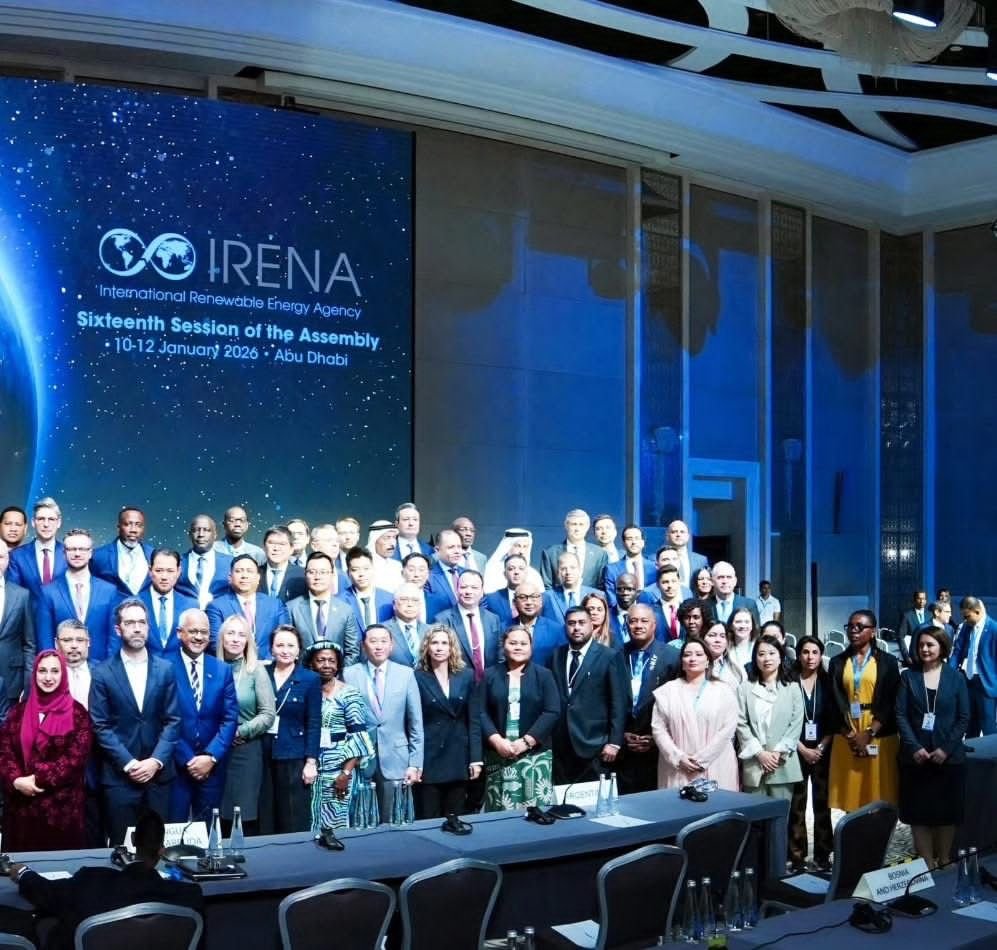
Abu Dhabi, January 11, 2026 — Pakistan highlighted its rapid advancement in solar energy deployment and inclusive clean-energy transition during the 16th Assembly of the International Renewable Energy Agency (IRENA), positioning itself among the world’s fastest-growing solar markets.
Presenting Pakistan’s national statement, Ms. Romina Khurshid Alam, MNA, Coordinator to the Prime Minister on Climate Change, underscored the country’s people-focused approach to renewable energy, driven by affordability, decentralisation and climate resilience.
She told delegates that by the end of 2025, Pakistan had installed 12 gigawatts of off-grid solar capacity and over 6 gigawatts of net-metered solar systems, reflecting a sharp rise in household and commercial adoption. She added that renewable sources accounted for a historic 53 percent of total electricity generation in the previous fiscal year, signalling a structural shift in the national power mix.
Emphasising the social impact of the energy transition, Ms. Alam highlighted government-led initiatives such as the Punjab Solar Panel Scheme 2026, which provides free or subsidised solar systems to low-income households to reduce energy poverty. She noted that distributed solar solutions have also helped restore electricity and livelihoods in flood-affected areas, offering a practical model for climate-resilient recovery in vulnerable regions.
Reiterating Pakistan’s long-term climate goals, she reaffirmed the country’s commitment to achieving 60 percent renewable energy in the power sector by 2030. She urged IRENA and its member states to scale up concessional financing for developing countries, recognise energy storage and green hydrogen as global public goods, and strengthen regional cooperation to enhance shared energy security.
Concluding her address, Ms. Alam reaffirmed Pakistan’s full adherence to the Paris Agreement and expressed confidence in continued collaboration with IRENA to advance a resilient, inclusive and low-carbon energy future.