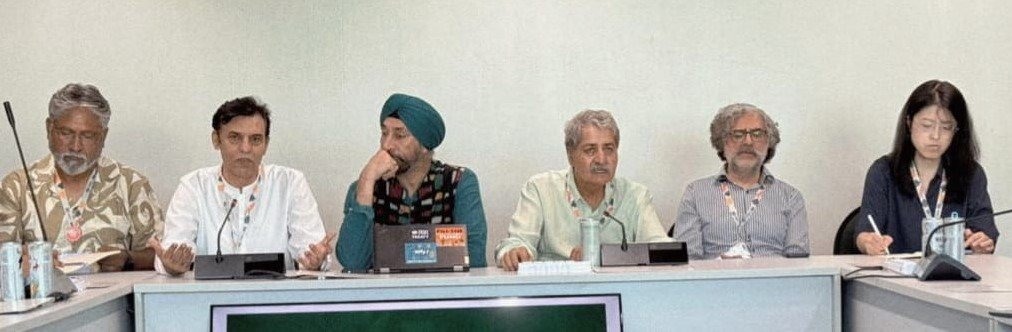
BELÉM: The South–South Exchange at COP30 opened with strong calls for climate finance, equity, and fossil fuel pledges. Parliamentarians, policy experts, civil society leaders, and private-sector representatives from Asia voiced concern over weak texts, slow negotiations, and inadequate commitments.
Naveed Qamar Warns of Existential Threats
Syed Naveed Qamar, Chair of the National Assembly Standing Committee on Finance and former Federal Minister for Finance, said Pakistan and other climate-vulnerable countries face existential threats from recurring floods, droughts, and glacial melt.
He noted that despite pledges after the 2022 floods, actual disbursements remained low. Pakistan refrained from launching another appeal after the 2025 floods due to debt concerns. Qamar added that Pakistan’s rapid solarization showed people’s willingness to transition to clean energy. “With proper climate finance, the pace would be far stronger,” he said.
Calls for Action at COP30
Dr Abid Qaiyum Suleri, Executive Director of the Sustainable Development Policy Institute (SDPI), said President Lula’s declaration of COP30 as the “COP of truth” highlighted the gap between ambition and delivery. He observed that the summit lacked clarity on climate finance, fossil fuel phase-out, and just transition.
He added that unresolved issues placed pressure on the Brazilian presidency, which had positioned COP30 as the “COP of Action.”
Regional Perspectives on Climate Finance
Ma Jun, an environmental policy researcher from Beijing, called for retaining earlier transition commitments and strengthening renewable-energy cooperation with developing countries. She cited Pakistan’s distributed solar expansion as a successful model and emphasized green-bond mobilisation.
Representing Germanwatch, Giovani said multilateralism within the UNFCCC system was weakening. He urged developing countries to strengthen cooperation and pursue trust-building steps.
Private-Sector and Civil Society Concerns
Dr Ayaz, Chairperson of the Pakistan Readymade Garment Manufacturers and Exporters Association (PRGMEA), highlighted pressure from EU Green Deal regulations. He outlined PRGMEA’s initiatives on biochar, renewable energy, biodiesel, and partnerships with universities and agencies.
From Bangladesh, Sharif Jamil of Waterkeepers Bangladesh warned that fossil fuel phase-out commitments without finance could trap developing economies. He said unpredictable monsoons and cloudbursts required more than private-sector interventions.
Fossil Fuel Debate and UNFCCC Reforms
Harjeet Singh, Global Expert at the Fossil Fuel Non-Proliferation Treaty Initiative, said the latest draft text contained no reference to fossil fuels and had a weak finance section. He welcomed the Colombia-led coalition of 80 governments supporting a fossil fuel phase-out roadmap outside the Paris Agreement.
A representative of the Alliance for Climate Justice and Clean Energy (ACJCE) urged reforms in the UNFCCC process, including transparent negotiations, curbs on fossil-fuel lobbyists, and stronger support for vulnerable groups.
Read related news here: https://thepublic.pk/category/business/
For more stories and insights, visit The Green Post