

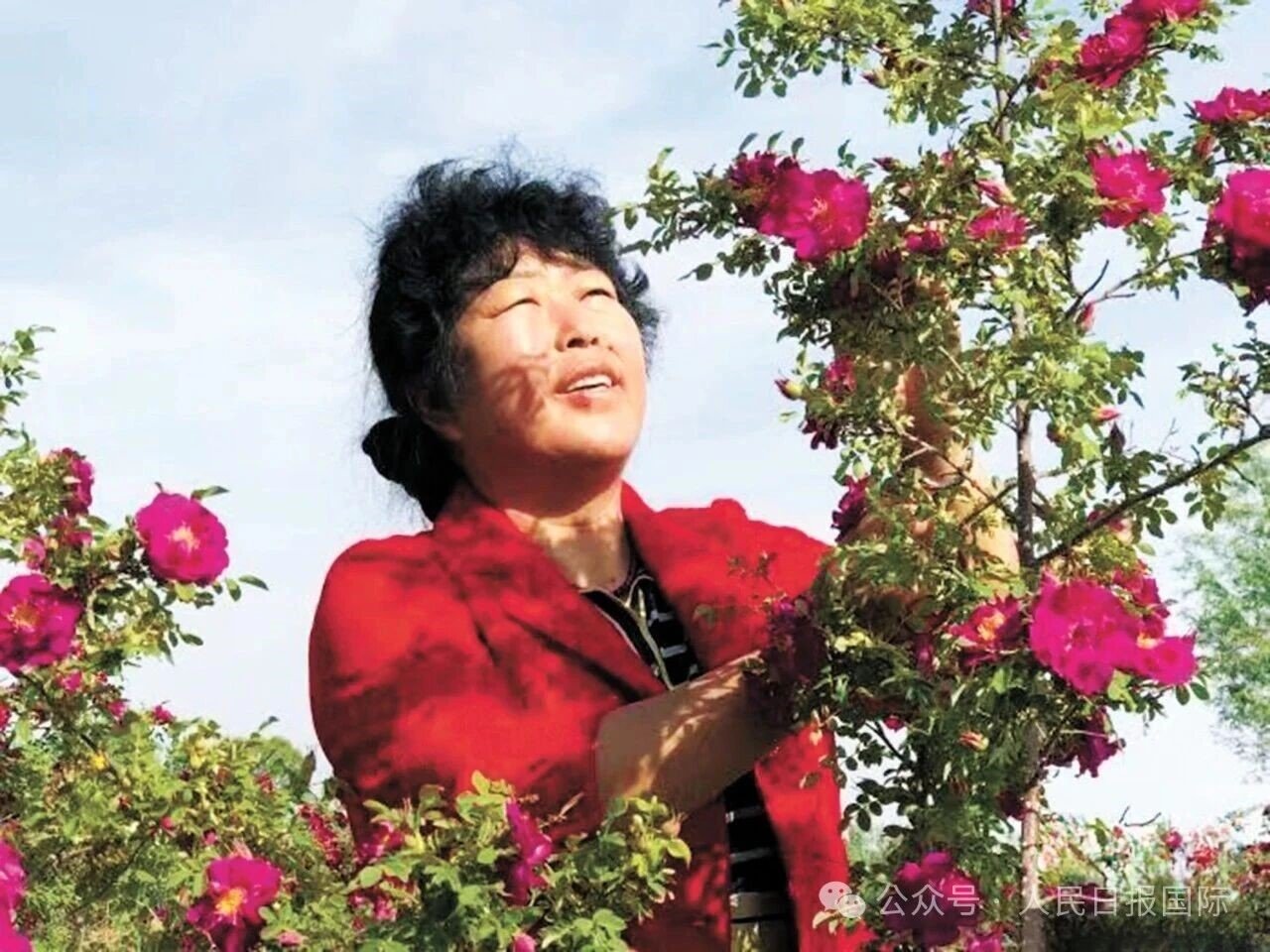
A cross-border friendship built around tree planting in China’s Maowusu sandy area has been rekindled after 26 years, following a viral video message from Chinese desertification fighter Yin Yuzhen to American supporter Ronald Sakolsky.
Yin, a national model worker in China who has spent decades combating desertification in north China’s Inner Mongolia autonomous region, recently posted a video searching for Sakolsky, who helped fund her tree-planting work in 1999. The message soon drew widespread attention online and led to an emotional reunion between the two through the internet.
“The trees you helped fund all those years ago have grown into a vast forest. When will you come and see them? I really want to meet you again,” Yin said in the video.
Sakolsky, now 69, was deeply moved after seeing the message from across the Pacific. He replied that he would try his best to visit China and hoped to plant another tree with Yin. The two have agreed to meet again in China in the near future.
The story began in 1999, when Sakolsky, then teaching at Luoyang Foreign Languages School in central China’s Henan province, watched a television program about Yin’s fight against desertification. Moved by her determination, he contacted several organizations in the United States to seek support for her work.
That October, a Boston-based institution donated $5,000 to Yin’s afforestation project. At the time, Yin was surprised that someone she had never met had placed such trust in her.
“A complete stranger raised such a large amount of money for me without even verifying who I was,” Yin recalled. “I had to plant those trees well. I couldn’t let that trust down.”
Yin used the donation carefully, planning which tree species would have better survival rates, where they should be planted to stabilize shifting sands, and how irrigation could save more water. Within months, seedlings began appearing across areas that had once been barren dunes.
In 2000, Sakolsky traveled to China with his colleague Bai Fan and met Yin in the Maowusu sandy area. With Bai serving as interpreter, Yin showed him the newly planted saplings.
According to Bai, Sakolsky was surprised by the harsh conditions and the limited tools Yin had at home. Although he admired her determination, he was uncertain whether the saplings would survive in such an environment.
Yin, however, remained determined. She hoped that one day Sakolsky would return and see that the small saplings had grown into a forest.
Today, that promise has largely been fulfilled. More than 50,000 trees were planted with the help of the donation Sakolsky raised, Yin said. Over the past four decades, more than 4,600 hectares of sandy land around her home have been rehabilitated, with more than 8 million trees planted.
In Uxin banner, where Yin lives, around 85 percent of the Maowusu sandy area has been brought under control, covering nearly 560,000 hectares. Forest coverage has risen to 32.92 percent.
Yin’s work began in 1986, a year after she married into Salawusu village in Uxin banner, Ordos. Surrounded by dunes, she believed the only way to hold back the shifting sands was to plant trees.
She sold one of her family’s sheep to buy 600 saplings and planted them around her home. A violent sandstorm later destroyed most of them, leaving fewer than 10 standing.
“If around 10 survived, later it might be 100, then 1,000,” Yin said.
Her persistence, combined with government-led anti-desertification efforts, helped gradually transform the landscape. The once-barren sandy area is now lined with shrubs, trees and stretches of woodland.
Sakolsky is not the only foreign friend inspired by Yin’s work. Over the years, volunteers from more than 20 countries and regions have visited her and joined tree-planting efforts.
Among them is Donald Ashton Jones, another American, who first learned about Yin in 2015 while teaching English in Harbin, northeast China’s Heilongjiang province. After watching a documentary about her work, he traveled to learn tree planting from her, began calling her his elder sister, and gave himself the Chinese name Yin Yifan.
Since then, Jones has returned almost every year when possible to plant trees and help stabilize the sands.
“ With more people worldwide showing concern, I came to understand that this is a dream shared by all humanity,” Yin said.
Along a tree-lined road in the area stands a stone monument inscribed with the words “Citizens of Earth.” On its back are the names of people from China and abroad who have supported the woodland in different ways.
Yin’s example has also inspired more than 240 major tree-growing households in surrounding areas, each having planted more than 200 hectares of trees.
“I hope to encourage more people to join tree planting,” Yin said. “Together, we can make our shared planet a better home for everyone.”


